For most of my life as a programmer, learning looked the same.
I watched tutorials. I followed along carefully. I trusted that if I finished the course, understanding would eventually arrive.
It usually did — slowly, unevenly, and with a lot of repetition. That was the deal. Programming was hard, information was scattered, and good explanations were rare. Sitting through hours of instruction felt like the price of entry.
Then AI showed up, and something unexpected happened.
I stopped watching tutorials — not intentionally, not as a rebellion, but because I no longer needed them. When I got stuck, I asked AI. When I forgot syntax, I asked AI. When I wanted an example, it appeared instantly.
At first, this felt like cheating. Then it felt efficient. Eventually, it felt different.
Because despite all that instant help, I noticed something strange: I wasn’t actually learning less. I was learning more — just not in the way I was used to.
Tutorials Gave Answers. AI Raised Questions.
Tutorials are built to remove friction. That’s their strength — and their weakness.
They guide you through a clean path. They anticipate mistakes. They smooth over uncertainty. When things work, you feel progress. When they don’t, you assume you missed a step.
But real programming is nothing like that.
Real problems are vague. Requirements are incomplete. Tradeoffs are uncomfortable. And no one tells you whether your approach is fundamentally wrong until much later.
AI doesn’t remove this uncertainty. In fact, it often exposes it.
When I ask AI for help, it answers confidently — but not always correctly. Sometimes the solution is elegant and wrong. Sometimes it works but makes assumptions I didn’t notice. Sometimes it solves a problem I didn’t actually have.
And that’s where the learning happens. Not when the answer appears, but when I push back.
Arguing Is Where Understanding Lives
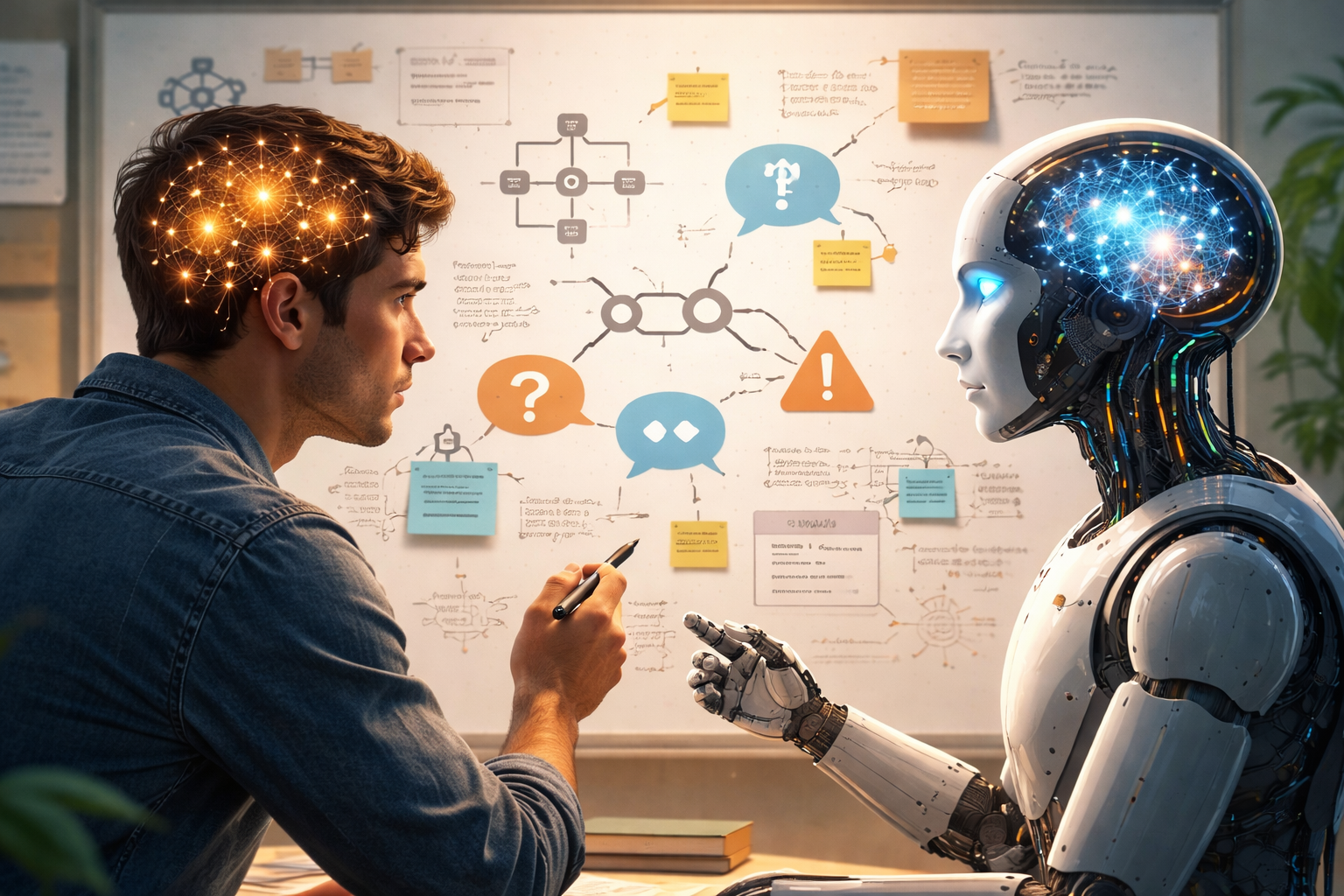
I’ve learned more by asking AI why than by asking it how. Not because the answers are better, but because they force me to slow down and think. When a solution looks clean but fragile, or correct but incomplete, I can’t move forward on autopilot. I have to examine assumptions, imagine failure modes, and decide whether the approach actually makes sense.
That kind of questioning doesn’t usually come from tutorials. Tutorials are designed to be helpful. They explain. They reassure. They guide you toward a working result and then move on. If something doesn’t work, the assumption is that you missed a step — not that the approach itself might be wrong.
AI behaves differently. It answers confidently — sometimes too confidently. When its answers don’t quite fit, I’m forced to push back. When it offers multiple options, I have to choose. And when I choose, I have to justify that choice, even if only to myself. That act of justification — of defending a decision rather than following instructions — is something tutorials rarely require.
This way of learning isn’t new. Long before programming courses existed, education was driven by argument. Law schools still rely on this method today for a reason: being questioned exposes what you actually understand. Comfort disappears; clarity emerges.
Arguing with AI feels like a modern version of that process. Not because AI is always right, but because it gives me something to push against. And in that resistance, understanding finally takes shape.
When Code Became Easy, Thinking Became Harder
AI made writing code cheap.
That sounds like progress, and it is. But it also shifts the burden of skill. When generating code is easy, the value moves upstream — to problem framing, to design, to judgment.
I don’t need to remember every API anymore. I need to know when an API choice is dangerous. I don’t need to memorize patterns. I need to recognize when a pattern is overkill.
The hardest part of programming was never typing. It was deciding.
I Write Less Code. I Read More.
Another quiet shift happened without me noticing.
I started spending more time reading code than writing it.
AI produces a lot of code quickly, but not all of it is good. Some of it is clever in the wrong way. Some of it is fragile. Some of it hides complexity instead of removing it.
Learning now means slowing down and asking:
- Is this understandable?
- Is this necessary?
- Would I want to maintain this a year from now?
These are judgment questions. They don’t have right answers. And that’s exactly why they matter.
Learning Without a Syllabus
I no longer “learn” a language before using it. I don’t finish courses end-to-end. I don’t feel guilty about skipping chapters.
Instead, I start building something real. I get stuck. I ask AI. I disagree. I revise. I break things. I reflect.
There’s no syllabus. No clean progression. Just friction.
And that friction is doing more for my growth than any perfectly structured course ever did.
What AI Actually Changed
AI didn’t make learning obsolete.
It removed the illusion that learning was about consuming information.
What remains is harder and more honest:
- thinking clearly,
- asking better questions,
- making decisions without certainty,
- and taking responsibility for the outcome.
Those skills were always required. AI just made it impossible to ignore them.
Final Thoughts
I didn’t stop learning when I stopped watching tutorials. I stopped outsourcing my thinking.
Tutorials are comforting because they tell you where to go next. They offer a path, a pace, and the reassurance that someone else has already figured things out. But real growth begins when that guidance disappears — when you’re forced to make decisions without knowing whether they’re right.
Arguing with AI didn’t make me better at producing answers. It made me better at questioning them. It forced me to slow down, notice assumptions, and defend choices instead of following instructions. In that process, I stopped measuring progress by how quickly I could build something and started measuring it by how well I understood what I was building.
AI didn’t change what it means to learn. It removed the shortcuts that made us think learning was passive. What remains is harder, less comfortable, and far more valuable: thinking clearly, choosing deliberately, and taking responsibility for the outcome.
And in the long run, that’s the kind of learning that actually lasts.