Living as a Software Engineer in the US (Part 1)
Categories:
This article was originally published in the December 2012 issue of Micro Software. I am reposting it on my blog with some additions and corrections that were omitted at the time due to length constraints.

Article published in Micro Software, a computer magazine in South Korea, December 2012
Living as a Software Engineer in the US (1)
The life of a developer in Korea, characterized by repeated overtime due to grueling project schedules, once led me to give up on my dream of being a developer. Afterward, I sought a completely different career path, but the charm of computer programming did not let me go easily, and I always felt a special compassion for the path of a software developer. Eventually, I decided to study computer science in the United States and find a job as a software engineer there. I faced many arduous processes while preparing for employment in a new major, dealing with the language barrier, and adapting to the unfamiliar environment of the US. However, I eventually succeeded in getting a job at a US company I desired and have been working as a software engineer ever since. I hope this story helps readers who are preparing to advance to the US, often called the “heaven” for software engineers, as I share my experiences preparing for local employment in the US.
Stan Lee | stanley.s.lee@gmail.com
After graduating with a Master’s degree in Computer Science from Yale University, I am currently working as a software engineer at Dell headquarters in Texas. Leveraging my background in Electronics and Computer Science and my experience as a hardware and firmware engineer, I am developing BIOS and UEFI for Dell computers. Life in the US is still unfamiliar, and every day is a challenge, but I am living with the joy of experiencing a new world.
The Hard Life of an Engineer
January 31, 2006. This was the day I finished my alternative military service and put an end to my career as a developer in Korea. (In South Korea, conscripts can sometimes serve via government‑approved civilian programs — I served as a software engineer at a small startup.)"
Since I was young, I had been interested in computers and programming, soldering numerous electronic kits and creating various programs with Turbo C. Choosing Electronic Engineering as my major in university allowed me to build a deeper relationship with computers. During my time at KAIST, my experience working as a founding member of a venture company made me think that my interest and talent lay more in software than hardware. However, the life of a developer I experienced during my alternative military service brought me great disappointment. Exhausted from constant overtime and grueling project schedules, I was shocked to hear from a hospital that I might have health problems due to overwork at the young age of early 20s. Furthermore, seeing that the monthly salary I received for working from morning till late at night, and sometimes even on weekends, was less than what I could earn from a few tutoring gigs, made me deeply conflicted about whether I should continue this work. As soon as my three years of three-year alternative military service ended, I put a period on that arduous life.
Studying Business and Dreaming of Studying Abroad
I worried a lot about what to do with my life. Ending my company life, I wanted to try studying business administration, which I had been interested in while working at a startup company during my college days. I applied for a bachelor’s transfer to Seoul National University’s Business School. I passed the initial screening and major exam, and thankfully, the final interview, starting my college life anew. During the two and a half years there, studying business administration, I dreamed of a completely different career. Around graduation, I interviewed with foreign consulting firms and investment banks, but conflict was brewing in my heart about whether this was truly the life I wanted.
I had been dreaming of studying in the US since my early 20s. I wanted to visit that land, driven by a longing for a new world and a desire to study and work in the US, the most developed country in the world. After graduating from KAIST, I had once prepared for studying abroad, but due to busy company life and various personal circumstances, the dream of studying in the US was fading. And if I were to join a foreign consulting firm or investment bank after graduating from business school, this dream would have to be put on hold for another few years. The possibility of working in the US seemed to diminish as I got older, and by the time I was graduating from my second university, I was already approaching thirty. A decision was needed.
I prepared for an MBA, which was very popular at the time. I took the TOEFL and GMAT, received scores eligible for application, and applied to MBA programs at top 10 US schools. However, the subprime mortgage crisis hit, and the number of applicants to US business schools surged. I prepared hard for over a year, but I didn’t receive an admission offer from anywhere. Thinking back, it might have been a natural result that I was rejected from all the schools I applied to, as I didn’t have a spectacular career at the time, and my only unique point was having studied both business and electronic engineering. The following year, I gathered my wits and decided to apply for a Ph.D. program in business, thinking I would study business administration, which I had studied most recently, a bit more in the US. A professor at George Washington University took an interest in my unique background of studying both IT and business, so I decided to apply there. I passed the document screening, and all four professors I had phone interviews with seemed to have a good impression and recommended me. I received the department’s recommendation, and now I only needed the recommendation from the school’s admissions office, the final gateway. Unfortunately, I was rejected at this final stage.
It felt like all the clocks in the world had stopped. I felt as if my efforts over the past two years had shattered and blown away into the air. I struggled in confusion about what I should do and which path I should take. However, as time passed, I began to face reality again and decided to challenge myself for one last year before giving up on studying in the US and choosing a career path in Korea. This time, there was no retreat. And this time, I had to break through this gateway.
I thought deeply about what I could do. Although I had left the IT industry more than four years ago, I had a deeper understanding of technology than anyone else, and I was someone who loved computers and programming. And now that I had also learned business administration, MIS (Management Information System), which combines IT and business, was one of the possible career paths. I steeled myself again and began preparing for the gamble of my life. I traveled to Japan several times to take the GRE, and to earn the necessary application fees, test fees, and living expenses, I juggled 7-8 tutoring jobs while applying to over 30 computer science graduate programs and MIS programs at business schools.
Among my friends preparing to study abroad, no one applied to as many schools as I did. I was that desperate; I couldn’t afford to fail now, so I was sprinting with all my might for the maximum possibility.
Yale

Yale University
There is a saying, “Do your best and wait for heaven’s will” (Jin-in-sa-dae-cheon-myeong). At that time, I was truly doing my best in my life and waiting for the result from God. In February 2010, the first place I heard from was Yale University, one of the most famous universities in the Ivy League along with Harvard. Later, I asked Linda, who was in charge of student services at Yale, and she said that 280 people applied for the CS Master’s/Ph.D. program that year, and 19 received admission to the Master’s program. Starting from that point, news of admissions and rejections began to fly in one by one. The places where I was finally accepted for the Computer Science Master’s were University of Michigan (Ann Arbor), Johns Hopkins, UC San Diego, UC Irvine, UC Santa Barbara, and for business school, I received an admission offer from the Eller College of Management at the University of Arizona, which is particularly famous for its MIS program.
I thought a lot about choosing a school in connection with my future career path. Since I wanted to find a job in a US company after graduating with a Master’s degree, I decided to choose Computer Science, where it is easier for foreigners to find jobs and where there is employment competitiveness even if one’s English is not perfect, rather than business school. And within Computer Science, I struggled a lot between the University of Michigan, which has a particularly high major ranking, and Yale, which has high school prestige. In the end, I chose Yale and left for the US.
Intense Job Hunting and Studies
New Haven, Connecticut, where Yale University is located, is a small European-style university town. It is a romantic place, but it is also a dangerous place where you can occasionally hear gunshots at night and should never walk alone after dark. I settled in an old and shabby apartment here and started my study abroad life with my wife.
In fact, when I first came to study, I thought Yale’s Computer Science Master’s program was two years long. However, after reading the department information carefully after admission, I found that I could choose from 1 to 4 years. I could adjust the graduation timing according to my plan, but there were minimum GPA requirements to graduate. Graduate grades in Computer Science at Yale are not given as A, B, C like in Korea, but are divided into Honor, High Pass, Pass, and Fail. To graduate, you need an average of High Pass, and at least one class with an Honor grade. In Yale’s graduate school, Pass is the grade you usually get if you work hard. To get a High Pass, you have to pour in a lot of effort, and getting an Honor was really difficult. Having not received a single Honor in the first semester, I had to constantly strive harder in the second semester to graduate. I prepared for homework, projects, and exams while sleeping only 2-3 hours a day, to an extent I had never studied so hard before. Since the tuition was expensive and health insurance was also very expensive, I studied really hard with the goal of graduating in one year to finish the degree as quickly as possible.
And since I came with the intention of getting a job as a software engineer in the US, I could never neglect finding a job. For almost 8 months from October 2010 to June 2011, I continued to revise my resume, write cover letters, and prepare for programming interviews and phone interviews while focusing on my studies. During the semester, I frequently received calls requesting phone interviews, and there were quite a few days when I spent 4-5 hours just doing phone interviews. Later, when I counted, I had sent out about 1,300 applications to companies, and I think I had about 70-80 phone interviews. At first, phone interviews were too difficult and it was hard to understand the questions, but after doing many interviews, I could quickly predict what questions would come out and my answers began to get organized. It seems that as experience accumulates, confidence grows, and you can overcome situations with ease. Programming interviews were also an area where I suffered at first because I didn’t have much background knowledge. Although I had worked as a software engineer in Korea, it was almost 5 years ago, and since I majored in electronic engineering in college, my understanding of important subjects in computer science such as algorithms and data structures was not deep. However, I diligently took classes in the Computer Science department at Yale and audited courses I lacked to build up the necessary knowledge. And my confidence in my major also grew.
One thing that stressed me out a lot while preparing for employment was the OPT (Optional Practical Training) issue. This OPT system gives you a chance to work in the US for a certain period if you graduate with a degree in the US. There is a period during which you can apply for OPT before or after graduation, and you can only apply for this once after receiving a degree in the US. Since my graduation was uncertain, whether to apply for OPT was also a big worry. If I applied for OPT but, by any chance, my grades for the last semester didn’t come out properly and I couldn’t graduate, there would clearly be a problem with the applied OPT. Fortunately, all grades released two weeks before graduation met the graduation requirements, so I could apply for OPT, but there were still many things to consider even after applying. If I couldn’t find a job in the US within 90 days after OPT started post-graduation, I would have to return to Korea, so my heart kept getting anxious while I continued to look for a job after applying for OPT.
Microsoft, LSI, and Dell
The first place I received an interview invitation from was Microsoft. Microsoft regularly held recruitment sessions at Yale University, interviewing Computer Science students and inviting them to Microsoft headquarters for onsite interviews. When they came for the session in the fall semester of 2010, I wasn’t prepared for programming interviews at all, so I couldn’t answer algorithm-related questions well and didn’t get an onsite interview invitation. However, in the spring semester of 2011, thanks to preparing for programming interviews for quite a long time, I answered all the questions from the interviewer who came to the school and received an invitation for an onsite interview in Redmond, Washington, where Microsoft headquarters is located.
I took an early morning flight to Washington to attend the onsite interview during the school’s spring break. Microsoft hosted a party the day before the interview, but I didn’t go for fear of being distracted the next day. Since much of the pass/fail decision is determined in the programming interview, I spent the night before the interview organizing algorithms and data structures and recalling expected questions and answers.
Finally, on the day of the decision, Microsoft sent a cool bus decorated with colorful neon signs inside for the interviewees. 15 minutes later, I entered a building at the headquarters and waited; looking around, everyone preparing for the interview looked clearly nervous. There were 4 interviews of 50 minutes each, all of which were programming interviews. Microsoft is famous for every developer having a private office, and for each interview, the interviewer would take me to their room.
In the first engineer’s room, he explained the project he was working on and asked what solution I could offer for a problem he was facing. My English was still poor at the time, so I couldn’t understand the question fully and asked again several times. I understood the question to some extent, set up a data structure in my own way, and presented a solution I thought of, but it didn’t seem to make a big impression. In the second engineer’s room, I was first presented with a problem to detect a cycle in a Linked List, and as conditions were added, I was asked to write Pseudo code for each. I wrote code on the whiteboard while exchanging questions with the engineer for an hour, and at the end, I heard “You are correct.” Hope began to rise a little. In the third room, the manager interviewer gave me a paper and a pencil, asked me to create a Tree according to his requirements, asked various things about Depth-first search and Breadth-first search, and then ordered me to implement an algorithm that met the conditions he required. After several attempts and discussions, another hour passed and I left the room. In the last room, I presented an algorithm for a given search in Pseudo code, and then I was asked to change the code I wrote in Recursive to Iterative and explain the pros and cons of the two codes. This was a part I already knew well, so I remember answering quite well. And all the interviews were over.
After lunch, everyone who interviewed that day gathered in one room. And whenever a name was called, Microsoft employees would take that person and disappear. My name was called, and a female employee guided me. While walking and talking about this and that, when I heard “Unfortunately…”, I could sense the result. Regrettably, my meeting with Microsoft ended there. There were about 15 people who interviewed that day, and I remember about 2 people passed.
Thanks to pitching with all my might in the last semester, I received good grades and was able to graduate from Yale in one year. Around graduation, I received an interview request from a company called LSI, which makes semiconductors related to networks and storage, and had phone interviews with two engineers. They must have thought the phone interview went well, as I later received an onsite interview invitation and went to Pennsylvania. I interviewed with 5 people, and it wasn’t as hard as Microsoft. I answered most of the programming questions and finished the almost 6-hour interview with a comfortable mind. However, about 3 weeks later, I heard from the manager that due to internal restructuring at the company, they had to prioritize hiring internal personnel, so the team couldn’t hire more external personnel. Another person I interviewed with that day told me that the team was positive about me, but they suddenly had to hire from internal resources and apologized. It was disappointing, but I had no choice but to promise the next challenge.
The third interview request I received was from Dell Computer in Texas. I had applied for several software engineer positions through Dell’s website, and a few months later, Dell suddenly called and asked if I was interested in interviewing for a BIOS engineer position. They had noticed my background of majoring in electronic engineering in undergraduate and studying computer science in master’s. I was not in a position to be picky. The OPT system, which gives employment eligibility in the US after graduating from graduate school, required returning to the home country if one failed to find a job in the US within 90 days of starting OPT after graduation. I had to find a job somehow. A few days after finishing the phone interview with the Dell engineer, a flight ticket to Texas arrived, and unexpectedly, I went to Texas for an interview.
I arrived in Texas in the sweltering heat and had an interview at Dell headquarters in a city called Round Rock. I interviewed with 6 people for 6 hours. I was asked basic concept questions about C/C++ and also required to give a brief presentation about the projects I had participated in. Along with basic concepts about the computer booting process and the role of BIOS, I was also asked to answer Behavior Questions predicting coping abilities in various situations in an organization. After the tense moments of 6 hours ended, I returned to the hotel to rest and was able to have a sweet sleep for the first time in a long while that day.
Three weeks later, I received offers from two teams at Dell. After salary negotiations, the official job offer letter arrived, and the deadline was one week. At the time, I was told that the next step for the Google interview I was proceeding with could take up to 6 weeks to be decided, so I stopped the process and decided to join Dell. And so, I started a new life in Texas with my wife.
What is a Software Engineer in the US?
The job-related site CareerCast.com selected Software Engineer as the best job in 2012 while selecting the best and worst jobs. By summing up average income, work environment, stress, physical labor intensity, and employment prospects and comparing them with other jobs, the result was that in the US, a software engineer was selected as the best job where one is socially recognized, works in a pleasant environment, and can earn a high income.
The first thing I could find after starting life as a software engineer at Dell was the balance between work and family life. Although it varies by company, most US companies adhere to working hours based on 9-to-5. However, in the case of IT companies, and for people working in software jobs, these working hours become a bit looser and are often left to individual discretion. At Dell, too, there are no set working hours for me. I usually leave home at 9 am by car, arrive at the office around 9:20 am to start my day, and finish work between 5 pm and 6 pm, repeating this life for almost a year. Of course, sometimes when work is busy, I work late in the evening, and sometimes I go to work on weekends. As everyone has different concentration times, some people start work around 7 am and leave early, and some come a little late and leave later than others. Also, if there are cases where one is late or cannot come to the company due to childcare or medical appointments, a culture is formed where most managers understand if you contact them. In my case, I was given 2 weeks of vacation in the first year, but if personal business arose, I could use 2 more weeks (of course, this must be discussed with the manager). While at it, I counted the official holidays given by the company besides vacation, and there were 11 more days. It is hard to find cases like in Korea where overtime is as common as eating meals and people come out to work on weekends.
There is a website called Glassdoor (www.glassdoor.com). Here, you can find out how much salary people belonging to a specific job group in a specific company receive. If you search for the salary of a software engineer at Google, the most representative one, you can see through the Glassdoor website that although there are individual differences, they receive an average of about $100,000 within the first year of joining. Since this salary is voluntarily posted by people who say they work at Google on this site, it is not 100% reliable, but it can be good data to roughly guess how much it is.
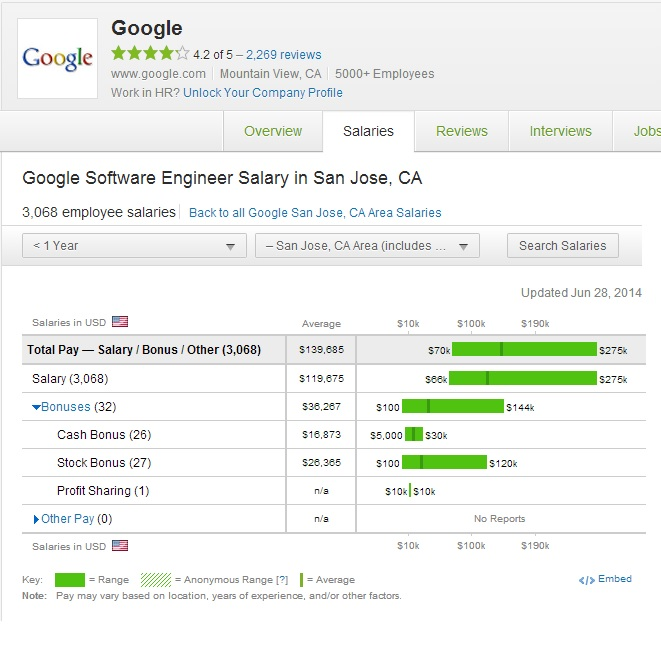
Google Software Engineer Salary in San Jose via Glassdoor.com (Entry Level)
In the case of Google, since it is the most successful IT company, the salary level is one of the highest. What about other large IT companies? Let’s pick famous companies like HP, Intel, and Amazon.com among the companies on the Fortune 500 list on the Internet and check the salary of software engineers on the Glassdoor site. Although it varies by person and job type, it allows you to roughly guess what kind of treatment you receive in the US.
Now let’s think about the case of Korea. Through newspaper articles, and for those who have worked in the field, you probably know what kind of life engineers in the IT field, who were once at the center of the Korean venture myth, lived. Although there are some differences by company and development job type, family often took a back seat while handling tight development schedules, enduring overtime and weekend work. This phenomenon is probably not unique to developers. If you look at Forbes’ “The World’s Hardest-Working Countries” article, it shows that South Koreans worked the longest hours among OECD countries that year. Looking at the OECD’s “Average annual hours actually worked per worker” statistics, the average annual working hours of Koreans from 2000 to 2007 were about 2400-2500 hours, the highest among 35 countries, and since 2008, it has ranked second by a narrow margin to Mexico. Since these statistics are averaged with large corporations with relatively good welfare levels, I have heard that in the case of small and medium-sized enterprises with relatively poor treatment, annual working hours exceed 3000 hours. I worked as a developer in Seoul, and to go to the company in Gangnam, I had to wake up early in the morning and take the crowded subway to get to work on time. I settled for toast sold at the subway entrance in the morning, resolved lunch and dinner at or near the company, coded while working overtime that day too, and left the company around 8-11 pm. Although no one forced me, I think I naturally got used to that life as most developers were living such a life. When I came home, it was dark night, and my body was soaked in fatigue, so I would order a late-night snack, watch TV, and fall asleep. After living like that for over 3 years, I couldn’t find much of my own life. I might have been able to live this life when I was single, but I don’t think I had the confidence to handle this life if I got married and had a family. So I think I voluntarily gave up this path.
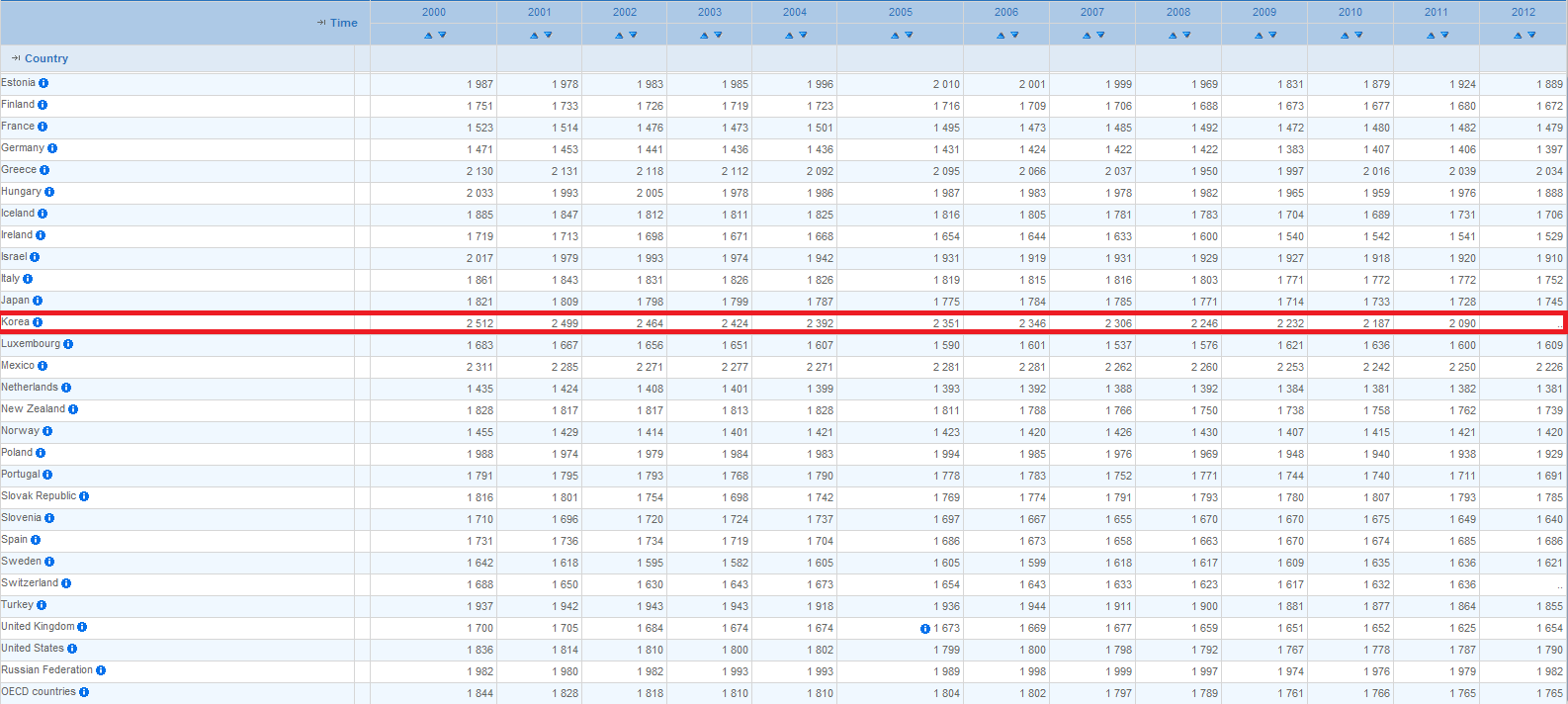
Average annual working hours of OECD countries - Showing Korea’s murderous working hours (Source: OECD.StatExtracts)
There is a fascinating fact I discovered when I joined Dell and started working. I could see people who were clearly grandfathers with gray hair still developing software. And one day, that person was congratulated at a meeting of the entire server part, and he said he had been working at Dell for over 20 years. Looking at the software engineers I work with, I could easily see cases of working at the company for 10 to nearly 20 years. Of course, Texas is a place where the influx of manpower is not as high as Silicon Valley, but in many cases, they were satisfied with the life of an engineer. I once heard that a manager position became vacant in a team, and they tried to pick a manager from among the internal engineers, but no one wanted to be a manager, so it became difficult. In Korea, everyone would have wanted to be a manager, which was very strange. This is because, due to the nature of Korean companies where engineers move up to management positions, promotion and salary can stagnate if you don’t become a manager. But it is different in US companies. This is because even if you stick to the path of an engineer for life, if you work hard at your job, you can be sufficiently recognized by the company and receive financial rewards.
At the time of finishing my Master’s in Computer Science at Yale, my friends who studied with me also started preparing for interviews, running around to find jobs after graduation. A unique point was that there were no Americans among the friends who entered as Master’s students. The Computer Science Master’s classmates consisted of 13 students from China, India, and Korea, and most of them were international students who came to study in the US for the first time. However, after graduation, all of these friends were employed by major US companies (excluding those who went on to graduate school or voluntarily returned to their home countries). I still keep in touch via Facebook occasionally, and looking at the companies they went to, most are famous major US companies such as Google, Oracle, Bank of America, Bloomberg, and Qualcomm. In fact, this is surprising. I heard that the employment rate for foreigners who come to study in the US and graduate with a degree is around 5% due to various status issues and English problems. As someone who has seen many cases where people with Ph.D. degrees from prestigious US universities struggle to find local employment in the US and wait for several years while drifting through post-docs, it was hard to see it as just luck that all my Master’s classmates got jobs at good companies within a year of coming to the US. This was due to the US job market, which has many doors open for software engineers.
So why is the door for software engineers wide open to foreigners in the US?
First, the scarcity value of software engineers. I believe that the social value of a job is determined by scarcity. If demand is high but production is low, treatment is bound to be good. I have experienced three US universities so far. The first was UC Berkeley, where I came for summer school during college, the second was the University of Arizona, where I came for language training, and the third was Yale, where I did my Master’s degree. When I asked American friends in undergraduate what they wanted to do in the future, most of the answers were three things: Medical School, Law School, and Business School. Although there are differences by region and school, the number of students majoring in engineering and wanting to make it their lifelong career is decreasing across US society, and foreigners are filling those spots. However, while the number of students coming to study engineering is limited, IT companies in the US continue to prosper. Also, engineering has high entry barriers, so it is not a field anyone can jump into just because they want to. It is a field that can be done by passionate people who are willing to study for a long time and handle difficult and hard work in actual practice.
The second reason for the good treatment of software engineers in the US is legal reasons. US companies hire many capable foreign software engineers, but it is legally stipulated that their treatment should not be different from Americans. It is not just a formal law; if there is discrimination in salary, treatment, environment, etc., between hired foreigners and Americans, it is recognized as a discrimination problem, which is considered the biggest problem in the US, and can become a lawsuit subject to huge fines. Foreign workers working in a country other than their own often face many disadvantages in terms of money and treatment in many countries except the US. However, at least in the US, it is set by law not to discriminate against foreigners if they have the right to work legally. In fact, this issue stems from a plan to protect citizens rather than to treat foreigners well. If foreigners are hired by US companies at lower wages than citizens, confusion arises in the employment market, leading to a phenomenon where the wages of all Americans are lowered. To prevent this phenomenon, hiring foreigners is allowed only for companies that pay wages relatively similar to Americans. It comes from the intention to hire Americans if possible if the ability is the same.
Third, dependence on foreign developers in the US IT industry. US universities have voiced concerns in the IT industry as interest in computer-related departments, including computer science, has dropped among Americans every year, and the number of actual enrollees has decreased. Please remember that I mentioned earlier that there were no American entrants in Yale’s Computer Science Master’s program. In fact, IT-based companies like IBM have provided a lot of financial support and manpower to universities, requesting them to provide more manpower to the IT field. However, in the case of smart American students, the majority hope to become doctors, lawyers, or work as bankers on Wall Street, so naturally, computer-related technologies have moved away from the interests of most American students. Many IT companies leading technology development are currently based in the US, and as their business base grows, they need more engineers with high-level skills. If the scope of the labor market is composed only of Americans, it is too small to handle the demand, but if it targets foreigners worldwide, the range of engineers that can be hired widens significantly. Also, if foreign engineers are hired, they must be treated the same as Americans, so talented foreign engineers dreaming of the American Dream come to the US and settle in major US IT companies like Microsoft, IBM, and Intel. Generally, foreign engineers work harder to make their value known technically, even if their English is a bit lacking. From the company’s perspective, since these hard-working engineers produce good results and are satisfied with company life, they need more foreign talents as IT talents in the US decrease.
Conclusion…
It took 11 years from the time I dreamed of studying in the US at the age of 20 to finally come to study in the US. Although I worked as a hardware/software engineer in Korea, it was hard to be sure if I could continue this work as I got older. I tried changing my major in the middle and tried to advance into other fields, but the biggest reason I dreamed of advancing overseas seems to be that I couldn’t find the balance between work and family life according to the lifestyle I desired.
There were many difficult times after coming to study in the US. I had to find information on the internet countless times for things that would have been easy to do in Korea, ask people, and attempt phone calls, which were most fearful for me with poor English. For a year, I learned American life hard while hitting the ground running, learned a new major, and even challenged myself for local employment in the US. And thankfully, I am now living the lifestyle I dreamed of in Texas.
Yesterday, all the server engineers at Dell gathered for a general meeting. There were hundreds of people, and there was a time to applaud and thank engineers who had worked for 5, 10, 15, 20, and 25 years. 25 years… I wondered if I could work as an engineer in one company for 25 years in Korea. Seeing grandfathers and grandmothers with gray hair working as engineers, I thought that the US might be one of the best environments for engineers to work.
If your life is flowing differently from what you think, I would like to advise you to constantly challenge other opportunities. Whether it is overseas employment, changing to another job, or starting your own business, I think you can dream of a better life when you find an aptitude that suits you and constantly challenge yourself. I also spent a long time in my 20s worrying, ‘This isn’t it, that isn’t it either..’, and I think I have finally found what I want. It took quite a long time, but since I found what I wanted, I think it was a very meaningful time for me.
Whether it is the US, Australia, or Japan, it seems that more and more IT engineers are thinking about overseas employment. From the outside, Korean society is a really narrow society. It is a society where countless people are concentrated in the Seoul area on a small land, constantly competing, and busily turning like a hamster wheel. If you turn your eyes a little and look overseas, you will be able to find multinational companies that need capable IT engineers. Working in another country and learning the culture of this country anew is also a difficult process of resetting many things learned in Korean society so far and learning everything again. However, if you want to see a wider world and experience a different world, it would be good to try another adventure once in your life. Although there is the obstacle of English, doesn’t a software engineer speak with technology and skills? They said where there is a will, there is a way. I want to say that overseas employment as a software engineer is not impossible if you look for it hard and challenge yourself.
In the next issue, I will look in more detail at what to keep in mind when looking for a job in the US and what process you need to go through to work as a software engineer locally in the US.
Reference
[1]: “The 10 Best Jobs of 2012”, CareerCast.com
http://www.careercast.com/jobs-rated/10-best-jobs-2012
[2]: “The World’s Hardest-Working Countries”, Forbes
http://www.forbes.com/2008/05/21/labor-market-workforce-lead-citizen-cx_po_0521countries.html
[3]: “OECD.StatExtracts Average annual hours actually worked per worker”
http://stats.oecd.org/Index.aspx?DatasetCode=ANHRS
https://web.archive.org/web/20210920022625/http://www.stanstory.com/?p=6